Free Study Guide
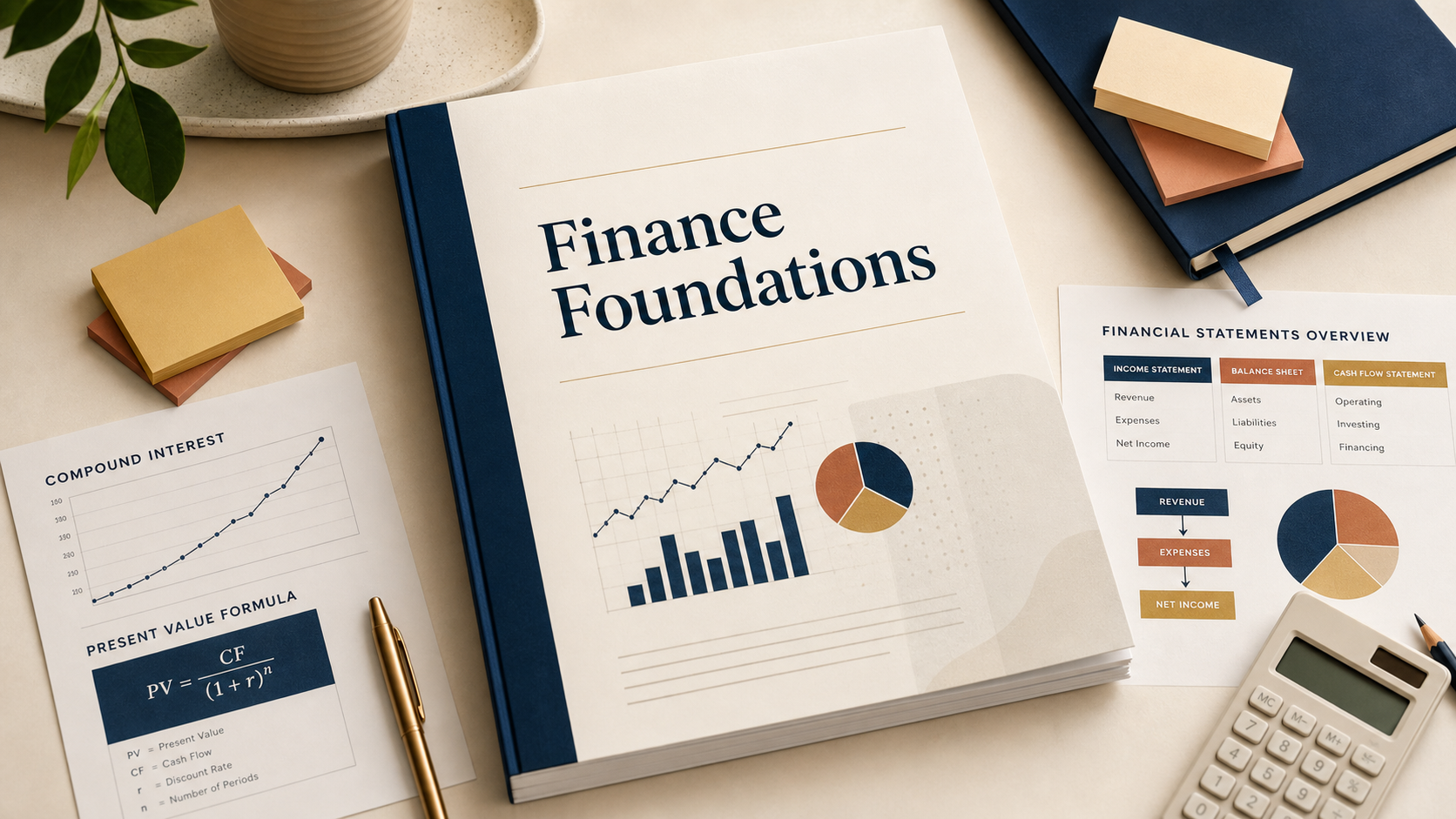
Finance Foundations
A practical, beginner-friendly guide to markets, money, risk, and financial statements.
- How stocks and bonds work.
- Why rates and inflation move markets.
- How to read the three main financial statements.
- How to think about risk, diversification, and compounding.
Page 2
How to Use This Guide
This guide is meant to make finance feel less like a wall of vocabulary. Each page explains one idea, shows how it appears in the real world, and gives you a simple way to remember it. You do not need prior experience.
By the end, you should be able to read a basic market article and understand what it means when people talk about stocks, bonds, interest rates, inflation, earnings, cash flow, and risk.
Read actively
Do not memorize every sentence. Circle the words that repeat: yield, valuation, earnings, margins, inflation, debt, and cash flow. Those words are the map.
Use the examples
The examples are short on purpose. They show the kind of thinking investors use before they ever touch a spreadsheet.
Review the quiz
The quiz at the end checks whether you can explain the ideas in plain English, which is the best sign that you actually understand them.
Core Learning Path
- Learn the major asset types: stocks, bonds, and cash.
- Understand risk, return, diversification, and compounding.
- Connect interest rates and inflation to markets.
- Read the basic story inside company financial statements.
- Practice by explaining each idea without looking at the page.
Page 3
Stocks: Owning a Piece of a Business
A stock represents ownership in a company. When you buy a share, you are buying a small claim on the company's future profits and value. Stock prices change because investors constantly update what they believe the business will be worth in the future.
Why stocks rise
- Sales grow faster than expected.
- Profit margins improve.
- The company gains a stronger competitive position.
- Investors are willing to pay more for each dollar of profit.
Why stocks fall
- Growth slows or costs rise.
- Interest rates make future profits less valuable today.
- Debt, competition, or weak management increases risk.
- The stock became too expensive compared with expectations.
A company earns $10 billion this year. If investors believe those profits can grow for a long time, the stock may trade at a high price. If investors later think growth is slowing, the stock can fall even if the company is still profitable.
Page 4
Bonds: Lending Money for Interest
A bond is a loan. Governments and companies issue bonds when they want to borrow money. Investors buy those bonds and receive interest payments. At maturity, the borrower is expected to repay the principal.
Key bond terms
- Principal: the original amount borrowed.
- Coupon: the interest payment.
- Maturity: when principal is due back.
- Yield: the return investors expect.
Why bonds matter
Bond yields influence mortgages, credit cards, business loans, government interest costs, and stock valuations. When yields jump, the whole financial system feels it.
If stocks are ownership, bonds are lending. Stock investors want the business to grow. Bond investors mostly want to be paid back on time.
Page 5
Interest Rates and Inflation
Interest rates are the price of borrowing money. Inflation is the rate at which prices rise over time. These two ideas are connected because central banks often raise interest rates when inflation is too high.

When inflation is high
People lose purchasing power, companies may face higher costs, and central banks may keep policy tighter. Markets become more sensitive to every inflation report.
When rates rise
Borrowing becomes more expensive. Bonds can become more attractive. Stocks, especially high-growth stocks, often face pressure because future profits are discounted more heavily.
Page 6
Risk, Return, and Diversification
Risk is the chance that an investment performs worse than expected. Return is the gain or loss from owning it. In general, investors demand higher expected returns when they take more risk.

Concentration
Owning only a few investments can increase upside, but it also increases the chance that one bad decision hurts the whole portfolio.
Diversification
Spreading money across companies, sectors, assets, and countries can reduce the damage from any single mistake.
- Market risk: the whole market falls.
- Company risk: one business disappoints.
- Interest-rate risk: rates move against an investment.
- Liquidity risk: something is hard to sell quickly.
Page 7
Compounding: When Returns Earn Returns
Compounding happens when your gains start producing their own gains. It is one of the most powerful ideas in finance because time can turn small differences into very large outcomes.
| Starting Amount | Annual Return | After 10 Years | After 30 Years |
|---|---|---|---|
| $1,000 | 5% | $1,629 | $4,322 |
| $1,000 | 8% | $2,159 | $10,063 |
| $1,000 | 10% | $2,594 | $17,449 |
Time matters
The earlier compounding starts, the longer it has to work. This is why investing education often emphasizes patience.
Rate matters
A few percentage points can create a huge difference over decades, but higher expected returns usually come with higher risk.
Behavior matters
Compounding can be interrupted by panic selling, high fees, or taking risks you cannot stick with.
Page 8
The Three Financial Statements
Financial statements tell the story of a business. They show whether a company is growing, whether it is profitable, what it owns, what it owes, and whether it actually produces cash.

Income Statement
Shows revenue, expenses, and profit over a period of time.
Balance Sheet
Shows assets, liabilities, and equity at one point in time.
Cash Flow Statement
Shows cash generated or used by operations, investing, and financing.
Net income starts on the income statement. It flows into retained earnings on the balance sheet and is adjusted on the cash flow statement to show actual cash generated.
Page 9
How to Read a Company Like an Investor
You do not need to be an accountant to start reading a company. A beginner can learn a lot by asking five basic questions and looking for the same clues across the statements.
1. Is revenue growing?
Revenue shows demand. Strong revenue growth can mean customers want more of what the company sells.
2. Are margins improving?
Margins show how much of each sales dollar becomes profit. Better margins can mean pricing power or cost discipline.
3. Does it produce cash?
Profit is useful, but cash keeps a business flexible. Cash flow helps fund investment, debt repayment, and dividends.
4. Is debt manageable?
Debt can help a company grow, but too much debt can become dangerous when rates rise or sales slow.
| Question | Where to look | Why it matters |
|---|---|---|
| Is the company growing? | Income statement | Growth supports future value. |
| Is it financially sturdy? | Balance sheet | Strong finances reduce risk. |
| Does it generate real cash? | Cash flow statement | Cash gives management options. |
Page 10
Market Vocabulary You Will See Often
Financial news can feel confusing because it uses a lot of shorthand. These are words you will see again and again.
When markets move, ask three questions: What changed? Which asset moved first? Why does that matter for companies, consumers, or investors?
Page 11
Putting It Together: A Market Day Example
Imagine a day when an inflation report comes in hotter than expected. Bond yields rise because investors think the central bank may keep rates higher for longer. Stocks fall, especially expensive growth stocks, because higher rates make future profits less valuable today.
How to explain it in plain English
The market is not reacting to one number in isolation. It is reacting to what that number might mean for interest rates, borrowing costs, company profits, and how attractive stocks look compared with bonds.
Higher inflation can lead to higher rates. Higher rates make money more expensive. When money gets more expensive, investors usually become less willing to pay very high prices for future growth.
Page 12
Review Checklist and Practice Quiz
Checklist
- I can explain the difference between a stock and a bond.
- I know why higher interest rates can pressure stock prices.
- I understand how inflation affects consumers and companies.
- I can name the three main financial statements.
- I can explain why diversification reduces single-investment risk.
- I can describe compounding without using a formula.
Practice Questions
- What does a stock represent?
- Why do bond yields matter for the stock market?
- How can inflation affect a company's profits?
- What does the cash flow statement show?
- Why is compounding more powerful over long periods?
- Why can debt become more dangerous when rates rise?
Pick one financial news headline and explain it using at least three ideas from this guide. For example: rates, inflation, earnings, valuation, cash flow, or risk.
Next recommended guide: Market Literacy.